
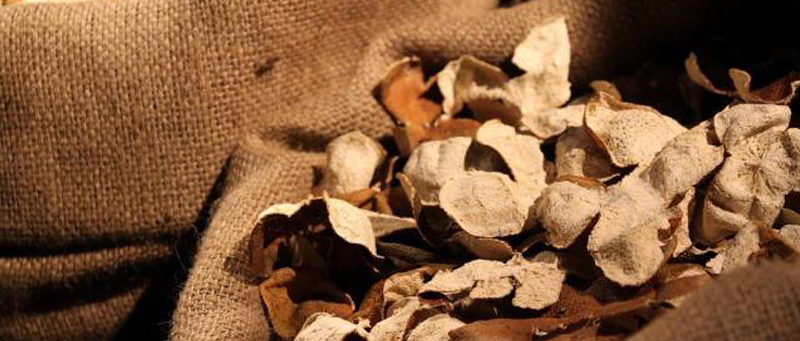
In the bustling food stalls of Guangdong, at family dinner tables across southern China, and increasingly in the teacups of wellness enthusiasts worldwide, one humble ingredient has reigned supreme for over seven centuries: chenpi — aged tangerine peel.
But not just any chenpi. The most revered comes from Xinhui, a district in Jiangmen City, Guangdong Province, where a unique combination of geography, climate, and centuries-old craftsmanship transforms ordinary citrus peel into something extraordinary. Known as the “first of the Three Treasures of Guangdong,” Xinhui Chenpi has earned a legendary reputation captured in the old saying: “One tael of chenpi is worth one tael of gold; a century-old peel surpasses gold.”
In this post, we’ll explore how this ancient ingredient addresses modern wellness needs, why Xinhui stands above all other origins, and how you can incorporate this “medicine and food homology” treasure into your daily life.
The Modern Health Challenges Xinhui Chenpi Solves
Before we dive into history and tradition, let’s talk about you — the modern tea drinker navigating a world of heavy meals, digestive discomfort, seasonal coughs, and daily stress. Xinhui Chenpi addresses these very real concerns with gentle, time-tested efficacy.
Pain Point #1: “I feel bloated and sluggish after eating.”
You’ve just finished a satisfying meal — perhaps something rich, fatty, or simply larger than intended. Instead of feeling energized, you feel weighed down, gassy, and uncomfortable.
How Xinhui Chenpi helps: The volatile oils in Chenpi have a mild stimulating effect on the gastrointestinal tract, promoting the secretion of digestive juices and helping eliminate gas accumulation in the intestines. In Traditional Chinese Medicine (TCM), Chenpi is known to regulate Qi (vital energy) and strengthen the spleen — which in TCM terms means enhancing the body’s ability to transform food into usable energy and eliminate waste. Modern research has confirmed that Chenpi can effectively treat functional dyspepsia, with studies showing that 20-year-aged Xinhui Chenpi produces particularly satisfactory therapeutic results.
The old TCM saying goes: “Fish creates heat, meat creates phlegm.” That’s why Chenpi is especially suited for those who frequently enjoy rich, meat-heavy meals — it helps your body process what you’ve eaten, reducing that post-meal regret.
Pain Point #2: “My throat feels congested, and I can’t stop coughing.”
Whether it’s seasonal allergies, a lingering cold, or simply living in a dry or polluted environment, respiratory discomfort affects millions.
How Xinhui Chenpi helps: Chenpi is traditionally used to dry dampness, loosen phlegm, and relieve coughs. It can stimulate the bronchial passages, making it easier to expectorate sputum. In TCM theory, Chenpi’s warming nature helps dispel cold from the lungs, making it particularly effective for wind-cold coughs with thin phlegm and chest congestion. A warm cup of Chenpi tea can soothe an irritated throat and help clear respiratory passages naturally.
Pain Point #3: “I feel heavy, lethargic, and my digestion is slow.”
This feeling of “heaviness” — often accompanied by a thick coating on the tongue, low energy, and a tendency to retain water — is what TCM calls “dampness.” It’s a common complaint in modern life, exacerbated by processed foods, air conditioning, and sedentary habits.
How Xinhui Chenpi helps: Chenpi is considered the premier herb for eliminating dampness and invigorating the spleen. One TCM practitioner explains it simply: Chenpi promotes gastrointestinal motility and metabolic capacity, enhancing the flow of Qi through the digestive tract and facilitating the elimination of metabolic waste (including “dampness”). In other words, it helps your body process and eliminate what it doesn’t need, restoring a sense of lightness and vitality.
Pain Point #4: “I want a natural, caffeine-free daily wellness ritual.”
Coffee gives you jitters. Sugary sodas leave you crashing. And many herbal teas feel either too medicinal or too bland to become a daily habit.
How Xinhui Chenpi helps: Xinhui Chenpi tea is naturally caffeine-free and offers a warm, complex flavor profile — first slightly sweet, with a pleasant pungent and bitter aftertaste that lingers on the palate. It can be enjoyed at any time of day: as a morning digestive tonic, an afternoon pick-me-up without the caffeine spike, or an evening wind-down beverage. Its versatility means you never get bored — one day you might drink it straight, the next you might blend it with Pu’er tea, white tea, or red dates.
Why Xinhui? What Makes This Chenpi So Special?
If you search online for chenpi or aged tangerine peel, you’ll find many options. But connoisseurs and TCM practitioners unanimously agree: Xinhui Chenpi is the gold standard.
The Geographic Advantage
Xinhui’s unique location creates conditions that cannot be replicated elsewhere. Situated at the convergence of three bodies of water — the Xijiang River, the Tanjiang River, and the South China Sea — Xinhui benefits from a “three-water convergence” phenomenon where fresh and saltwater mix, creating an alluvial plain of extraordinary fertility.
The region enjoys a tropical maritime monsoon climate with ample heat, abundant rainfall, and an extensive frost-free period. Nestled between Guifeng Peak to the north and Gudou Mountain to the south, facing the sea, Xinhui’s microclimate provides the perfect conditions for cultivating the tea-branch mandarin (Citrus reticulata ‘Chachi Gan’) — the specific variety used to produce authentic Xinhui Chenpi.
What Science Says
Modern research has confirmed what traditional knowledge has long asserted: Xinhui Chenpi is chemically distinct from chenpi produced elsewhere. Studies have found that the content and types of active chemical components and trace elements in Xinhui Chenpi differ significantly from those in chenpi from other regions. The volatile oil composition is richer and more complex, and the aroma profile is more fragrant — a direct result of Xinhui’s unique terroir.
One scientific paper noted that obtaining chenpi from either Sichuan or Xinhui provided potentially superior health benefits compared to conventional chenpi sources.
The “Aged Is Better” Principle
One of the most fascinating aspects of Xinhui Chenpi is that it improves with age — a rarity in the world of food and medicine. The TCM principle “chen jiu zhe liang” (the older, the better) has been validated by modern science.
As Chenpi ages:
- Small-molecule volatile oils gradually decrease, while large-molecule volatile oils increase, resulting in a more refined, elegant aroma.
- Total flavonoid content and hesperidin content increase significantly — and total flavonoids are considered key active components of Chenpi.
- The peel becomes more gentle on the body, less likely to deplete vital energy, and more effective overall.
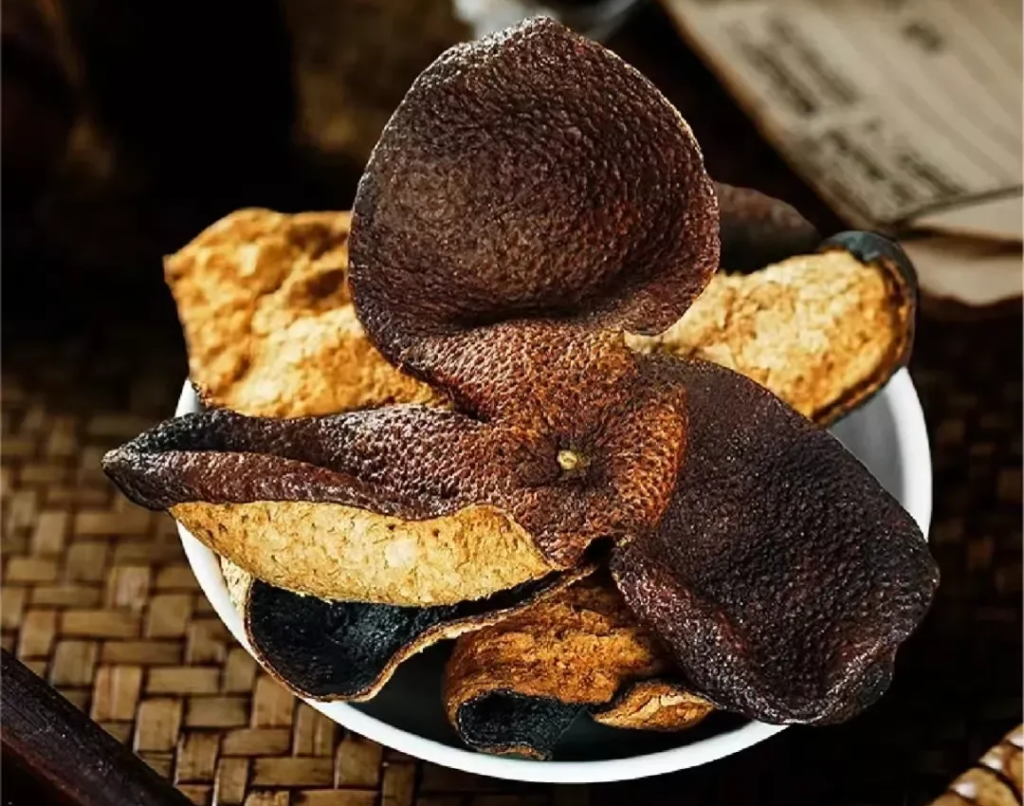
This is why authentic Xinhui Chenpi is never rushed. It requires years — often decades — of patient aging in proper conditions, with regular sun-drying to prevent moisture damage.
A Journey Through Time: The Storied History of Xinhui Chenpi
The history of Chenpi stretches back over 1,000 years, but Xinhui’s particular relationship with this ingredient began around 700 years ago, during the Song Dynasty (960–1279).
From Song Dynasty to Imperial Tribute
By the Yuan Dynasty (1271–1368), Xinhui mandarins were being cultivated on a significant scale. During the Ming Dynasty (1368–1644), the famous pharmacologist Li Shizhen wrote in his monumental Compendium of Materia Medica that “the ones from Guangzhong are considered superior” — with Guangzhong referring to what is now Xinhui.
The Qing Dynasty (1644–1912) saw Chenpi reach new heights of prestige. Chen Liji, a Xinhui producer, was designated as a supplier of tribute to the imperial court. Possessing this Chenpi became a mark of honor among dignitaries.
Perhaps most significantly, the legendary Qing Dynasty physician Ye Gui (1667–1746) — one of the most famous doctors in Chinese history — specifically prescribed “Xinhui pi” (Xinhui peel) in his medical formulas, including the famous “Erchen Tang” (Two Old Drugs Decoction). This endorsement from a medical master cemented Xinhui Chenpi’s reputation as the finest available.
A Thriving Trade
During the Ming and Qing dynasties, Xinhui merchants transported chenpi by ship to provinces across China, leveraging the same trade routes they used for Xinhui’s other famous product: palm-leaf fans. A Qing Dynasty local gazetteer recorded the scale of cultivation: “Citrus trees are planted in tens of millions, encircling the fields. Every year, great merchants collect the peels and sell them to other provinces. Once they cross the northern mountains, their fragrance intensifies, and the profits are immense.”
By 1912, Xinhui’s county seat had 30 specialized Chenpi shops, distributing to Shanghai, Chongqing, and Guangzhou, from which the peels were re-exported nationwide. Annual production reached approximately 700 tons.
Modern Recognition
Today, Xinhui Chenpi is protected as a National Geographical Indication Product and a National Geographical Indication Certification Trademark. In 2011, Xinhui was officially designated “Hometown of Chinese Chenpi.” In 2021, the traditional processing techniques of Xinhui Chenpi were inscribed on the National Intangible Cultural Heritage list.
The industry has grown dramatically. In 2022, the total output value of Xinhui’s Chenpi supply chain reached 19 billion yuan (approximately $2.67 billion). By 2024, the full industrial chain value exceeded 26.1 billion yuan, with Xinhui producing approximately 9,000 tons of Chenpi annually.
The Art of Making Xinhui Chenpi: From Fruit to Treasure
Transforming a fresh mandarin peel into aged Chenpi is a meticulous process that has been refined over centuries. The traditional method involves seven distinct steps: fruit picking, washing, peel opening, softening, peel turning, sun-drying, and aging.
The Signature Three-Stripe Cut
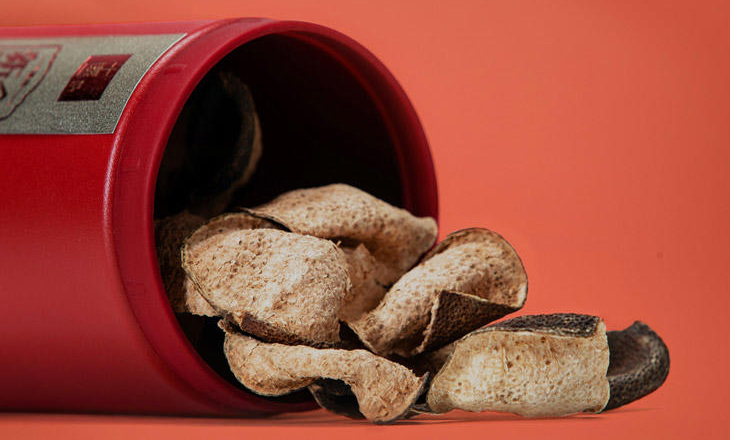
Authentic Xinhui Chenpi is instantly recognizable by its “three-stripe” (sān bàn) form — the peel is cut into three connected sections that open like a flower. This is achieved using either the “zheng san dao” (three-knife method) or “zheng er dao” (two-knife method), techniques that require years of practice to master.
Sun-Drying, Not Artificial Heat
Traditional Xinhui Chenpi is always sun-dried rather than artificially dehydrated. The peels are spread out in courtyards and turned regularly to ensure even drying. This natural process preserves the volatile oils and aromatic compounds that give Xinhui Chenpi its distinctive character.
The Long Aging Process
After initial drying, the peels are stored in breathable containers — traditionally clay jars or wooden boxes — in cool, dry, odor-free environments. For the first three years, the peel is considered merely “dried tangerine peel” — only after three years of aging does it officially become chenpi.
During aging, the peels must be checked regularly and re-sun-dried periodically to prevent moisture damage, especially during humid seasons. This is why authentic aged Chenpi is so precious — it requires constant care over many years.
How the Chinese Use Xinhui Chenpi: A Daily Wellness Companion
In Guangdong and across southern China, Chenpi is not a special-occasion ingredient — it is part of everyday life.
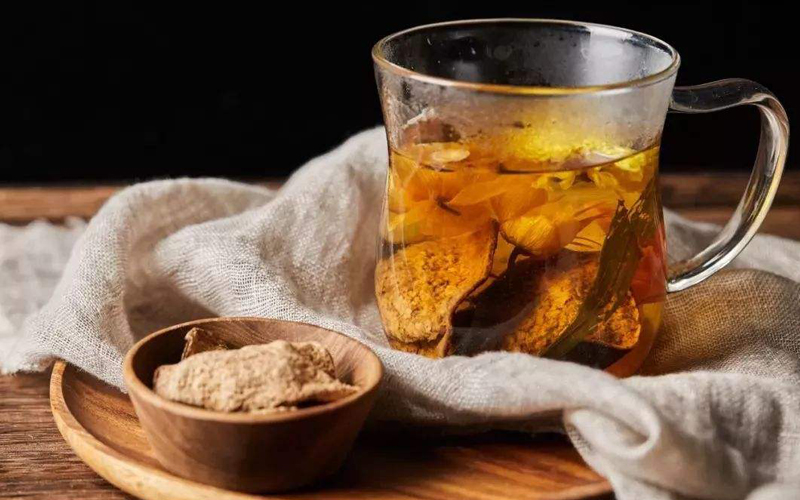
As a Tea: The Simplest, Most Effective Use
The most common way to enjoy Xinhui Chenpi is as a simple tea. The method is delightfully uncomplicated:
- Brewing method: Break off about one-third of a three-stripe peel, rinse briefly with boiling water to awaken the flavor, then steep in hot water. The same piece can be re-steeped 2–3 times.
- Boiling method: For a stronger brew, break the peel into small pieces, rinse, then add to cold water and bring to a boil. Simmer for about 10 minutes for a golden, soothing brew.
- Dosage: One whole three-stripe peel can be used to make tea for an entire day.
Blended Teas: Endless Possibilities
Xinhui Chenpi’s versatility shines when combined with other teas:
- Chenpi Pu’er: The earthy, fermented depth of Pu’er tea harmonizes beautifully with Chenpi’s citrusy freshness. This blend is particularly loved for its ability to aid digestion and relieve bloating.
- Chenpi White Tea: The subtle sweetness of aged white tea complements Chenpi’s pungent notes.
- Chenpi with red dates or goji berries: For a sweeter, nourishing brew that supports energy and immunity.
In the Kitchen: The Soul of Cantonese Cuisine
Chenpi is often called “the soul of Cantonese cuisine” — and for good reason. It appears in countless dishes:
- Chenpi Duck Soup: A classic Cantonese soup that combines Chenpi with duck, ginger, and dates for a warming, digestive-supporting broth.
- Chenpi Steamed Pork Ribs: The peel cuts through the richness of the meat, adding a subtle citrus fragrance.
- Chenpi Red Bean Soup: A beloved dessert soup where Chenpi transforms simple red beans into something extraordinary — the peel’s pungent notes balance the beans’ sweetness perfectly.
- Braised dishes and stews: Adding a small piece of Chenpi to braised pork or beef helps reduce greasiness and enhances overall flavor.
In Congee and Rice Porridge
A small piece of Chenpi added to congee (rice porridge) not only imparts a wonderful aroma but also helps relieve spleen and stomach discomfort while stimulating appetite.
Beyond Tea: The World of Xinhui Chenpi Derivatives
The Chenpi industry has expanded far beyond raw peels and tea. Today, there are over 100 product varieties across six major categories: medicine, food, tea, health products, cultural tourism, and even financial investment products.
Chenpi Snacks and Confections
- Chenpi-infused candies and pastries
- Chenpi chocolate and Chenpi cookies
- Chenpi plum and other preserved fruits
Chenpi in Alcoholic Beverages
- Chenpi wine and Chenpi liqueurs, which combine the warming properties of alcohol with Chenpi’s digestive benefits
Chenpi Health Products
- Chenpi capsules and extracts for convenient daily supplementation
- Chenpi-infused honey and syrups
Chenpi as Investment
High-aged Chenpi has become a collectible and investment asset. In 1988, a box of 30-year-old Chenpi was valued at 398,000 yuan (approximately $55,000) for just five jin (about 2.5 kilograms). At the Chenpi Culture Experience Hall in Xinhui, visitors can view century-old Chenpi displayed like precious artifacts.
Important Considerations: Who Should Be Cautious?
As wonderful as Xinhui Chenpi is, it is not for everyone in unlimited quantities. TCM teaches that because Chenpi is warm and drying in nature, certain individuals should exercise caution:
- Those with Qi deficiency with dryness: People who are prone to dry mouth, dry throat, and low energy may find Chenpi too drying.
- Those with Yin deficiency with dry cough: Chenpi’s drying nature can worsen dry coughs caused by Yin deficiency.
- Those with internal heat conditions: Individuals experiencing symptoms of excess heat (such as fever, red eyes, or constipation) should avoid Chenpi.
- Pregnant women: Should consult a healthcare provider before regular use.
- General guideline: For daily wellness, most people can enjoy Chenpi tea a few times per week, but excessive daily consumption may cause digestive discomfort in sensitive individuals.
The TCM expert Dr. Qiu Chaoping advises: “Chenpi is not a panacea. Its role is more focused on daily regulation rather than replacing medical treatment.” For most people, 3–5 year aged Chenpi provides excellent value and efficacy for everyday use, while 10+ year aged Chenpi, though more potent, comes with a significantly higher price tag.
How to Choose and Store Authentic Xinhui Chenpi
What to Look For
- Appearance: Authentic Xinhui Chenpi has a distinct three-stripe cut. The inner surface should show a yellowish-white or off-white color with tiny oil glands visible.
- Aroma: It should have a rich, complex fragrance — not just citrusy but deeply aromatic, with notes of aged wood and spice.
- Texture: Properly aged Chenpi should be dry and crisp, not soft or damp.
- Origin certification: Look for products with traceable Xinhui origin documentation. Some producers now include QR codes that trace the product back to its harvest location.
Storage Tips
- Store in a dry, well-ventilated, odor-free space
- Use breathable containers like clay jars, wooden boxes, or paper bags — not sealed plastic bags, which can trap moisture
- During humid seasons, sun-dry the peels monthly to maintain freshness and prevent mold
- Never store near strong-smelling foods, as Chenpi easily absorbs odors
Final Thoughts: Why Xinhui Chenpi Belongs in Your Kitchen
Xinhui Chenpi represents something increasingly rare in our modern world: a natural, time-tested remedy that actually works, backed by centuries of use and validated by modern science. It addresses real, everyday health concerns — from digestive discomfort and respiratory congestion to feelings of heaviness and lethargy — without harsh chemicals or unpleasant side effects.
But beyond its functional benefits, Xinhui Chenpi carries something else: a story. It is the story of a small district in Guangdong where farmers have cultivated the same citrus trees for 700 years, where grandmothers pass down sun-drying techniques to their grandchildren, and where a humble fruit peel transforms into something worth its weight in gold.
When you sip a cup of authentic Xinhui Chenpi tea — golden-brown, aromatic, warming — you are participating in a tradition that has connected Chinese families for generations. You are drinking not just tea, but history.
Ready to experience the magic of Xinhui Chenpi for yourself? Explore our collection of authentically sourced, properly aged Xinhui Chenpi — from accessible 3-year peels perfect for daily tea to rare vintages for the connoisseur. Your digestive system (and your taste buds) will thank you.